


.svg)
 (1).svg)

None of the studies we examine here proves that masturbation protects against prostate cancer. There is one large observational study in which men who ejaculated more often were diagnosed less often, and it cannot say whether frequency is the cause or simply goes along with something else. For Movember, it is worth more to learn what applies to PSA testing and to know what your testicles normally feel like.
THE ESSENTIALS IN 30 SECONDS
- Masturbation is common. The ISSM says there is no scientific basis for claims about infertility or sexual dysfunction.
- In the 2016 study, men with 21 or more ejaculations a month were diagnosed with prostate cancer 19% and 22% less often than men with 4–7. That shows an association and does not prove cause.
- The study measured ejaculation of every kind and does not separate masturbation. There is no "times per month" number that applies to you.
- Before a PSA test, the British NHS advises two days without ejaculation, anal sex and strenuous exercise or cycling.
- A lump, swelling or pain in a testicle, blood in your urine or blood in your semen: see a doctor, do not wait.
Every November, Movember turns attention to men's health: prostate, testicles, mental health. Greek sites carry headlines like "this many times a month is how often a man should climax". The headlines promise more than the studies say, so we opened the abstracts and wrote down what each one finds and where it stops. This text is for adults, 18+.
Does masturbation harm you?
We start with the basics. The International Society for Sexual Medicine (ISSM) writes that it is completely normal to masturbate, and cites a 2018 survey of 13,000 people in 18 countries in which 78% masturbated.
For the familiar scare stories, infertility and sexual dysfunction, the ISSM says there is no scientific basis and that none of these problems has been linked to masturbation. The same page lists possible benefits, such as less stress and better sleep.
Two situations are worth discussing with a doctor or sex therapist: when you feel guilty, or when it has become a compulsion that gets in the way of work and social life. The ISSM page says nothing about the prostate. The other myths have their own article: 7 sex myths.
Masturbation and the prostate: what the study of 31,925 men showed
The study behind the headlines is by Rider and colleagues, European Urology, 2016. It followed 31,925 men in the US, members of the Health Professionals Follow-up Study. In 1992 they reported how many times a month they ejaculated on average, at ages 20–29, at 40–49 and in the past year. They were followed until 2010, and during that time 3,839 were diagnosed with prostate cancer.
The researchers compared men with 21 or more ejaculations a month with men who had 4–7. The first group had a lower risk of diagnosis: 19% lower for frequency at 20–29 and 22% lower for frequency at 40–49, after adjusting for other factors. The association showed up mainly for low-risk cancer, was similar when restricted to men who had PSA tests, and, according to the authors, was unlikely to be explained by deaths from other causes.
The authors conclude that the findings add evidence for a beneficial role of more frequent ejaculation. This is where the brakes go on.
The first publication, in 2004
The same group of men had already been analysed in JAMA in 2004 (Leitzmann and colleagues), with 29,342 men aged 46–81 followed until 2000, so it is not independent confirmation. There, frequency at 20–29 showed no clear difference. At 40–49 and in the past year a lower risk showed up, while for advanced cancer the relationship was not statistically significant.
The most striking number of that study (relative risk 0.49, for the past year) has a very wide confidence interval, 0.27–0.88. The authors' official conclusion was more modest: ejaculation frequency is not related to an increased risk.
Why it does not prove you need X orgasms a month
The study is large. It also has limits, and most of them are visible in the abstract itself.
- Observation. The men were not randomly split into groups. According to the abstract, those who ejaculated more often at 40–49 also had a higher body mass index, more physical activity, more alcohol, more divorce and a history of sexually transmitted infections. The groups differed in many ways, not only in frequency.
- Memory. In 1992 participants reported from memory what they had done decades earlier.
- What was measured. Ejaculation, meaning sex, nocturnal emission and masturbation together, as the 2004 abstract defines it. The study does not separate masturbation.
- Who. Male health professionals in the US, not a representative sample of everyone.
| What the study shows | What it does not show |
|---|---|
| More frequent ejaculation goes with fewer prostate cancer diagnoses | That ejaculation causes the difference |
| The link appears mainly for low-risk cancer | A uniform picture for every form of the disease |
| Ejaculation of every kind was measured | The effect of masturbation on its own |
Association means two things show up together. Cause means one brings about the other. An observational study, however large, can only show the first. The weight is better placed on checking, not on a monthly quota.
What newer research says about frequency
A more recent study, by Pattison and colleagues in the Canadian Journal of Human Sexuality (2026), asked 1,578 men online about their motives and habits. Men in relationships had a better image of their genitals and more positive feelings about masturbation than men who were not. The model tested whether sexual well-being predicts frequency, not whether masturbation improves well-being.
The authors leave open that there may be an "optimal" frequency, neither too high nor too low, as a hypothesis for future research. So nothing here suggests that more is better. The study did not measure the prostate and gives no target number.
Movember: what to check in practice
If the month has one useful lesson, it is checking.
PSA: ask, do not guess
According to the NHS page on PSA testing (last reviewed 2 September 2024), routine PSA testing is not currently offered in the British system. The exception is people with a confirmed faulty BRCA2 gene. Any man can still ask his doctor, who will discuss benefits and risks. The risk is that the result may not be accurate and may lead to tests or treatment you did not need. A high PSA also does not necessarily mean cancer, since it can be caused, for example, by an enlarged prostate.
The most useful and least known detail is the preparation. For two days before the test, the NHS says, you avoid anal sex, ejaculation and strenuous exercise such as working out or cycling, because these can raise your PSA and make the test less accurate. Whatever the long-term link between frequency and the prostate, the day before the test has its own rules.
The NHS guidance describes the British health system. In Greece the framework and the labs' instructions may differ, so ask your urologist before you decide or prepare.
Testicles: know your own "normal"
The NHS on testicular cancer (reviewed 2 April 2024) says it is important to check your testicles regularly so you know what is normal for you. The signs it lists are a lump or swelling in a testicle, a testicle getting bigger, an ache or pain in a testicle or the scrotum, and a scrotum that feels heavy, firm or hard. If you notice any change that is not normal for you, make an appointment with a doctor.
When to talk to a doctor
- If you notice any of the above in your testicles.
- If you pee more often, feel a sudden urge to pee, get up several times at night to pee, see blood in your urine or have problems with erections. On the NHS PSA page these are listed as cases where testing may be recommended.
- If there is pain during ejaculation or blood in your semen. It is not something to wait on, ask a doctor.
- If you feel guilty or have lost control of the habit, in the way the ISSM describes.
If you are looking for a masturbator
In the chat on our site, quite a few people ask about masturbators with a stand or with movement. There are three questions worth asking: what material is it, how is it cleaned, and which lubricant suits it. You can see the whole range under masturbators, or the smaller, more anonymous ones under discreet masturbators. None of this relates to the prostate or promises anything for its health.
For pleasure and hygiene, two things help with almost everything: water-based lubricant and cleaning after use with a toy cleaner. Always read the instructions on the product page and the packaging of whatever you choose.
If prostate stimulation interests you, which is a different subject from the studies above, we have separate guides: prostate massage and male health and the prostate stimulation products.
A small, waterproof masturbator with a hard case so it fits anywhere:

A classic, basic choice:

With adjustable suction, where you control the intensity yourself:
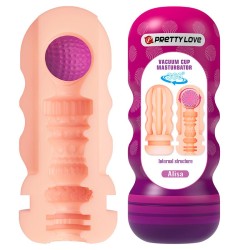
Pretty Love | Alisa | Vacuum Cup Masturbator with Textured Interior
€14.90 €24.90 -40%
In stock, last 4 units
View productFor cleaning after use:

And a water-based lubricant to start comfortably:

Frequently asked questions
Does masturbation harm you?According to the ISSM, it is completely normal and there is no scientific basis for claims that it causes infertility or sexual dysfunction. You need a doctor or sex therapist if you feel guilty or if it has become a compulsion that affects your work and relationships.
There is no number that applies to everyone. The 2026 study only leaves open, as a hypothesis, the possibility of an "optimal" frequency. The ISSM's line is not a number: it is the point where guilt appears or the habit gets in the way of work and relationships.
That has not been proven. The 2016 study found that men who ejaculated more often were diagnosed less often, but it was observational and measured ejaculation of every kind. For your own prostate, the answer lies in a conversation with a urologist.
The NHS advises two days without ejaculation, anal sex and strenuous exercise or cycling before the test, because they can raise your PSA. The source is British, so ask the lab or your urologist what applies in your case.
The NHS stresses that the aim is to know what is normal for you so you notice a change. A lump, swelling, enlargement, pain, or a heavy, firm or hard scrotum is a reason to see a doctor.
The ISSM writes that there is no scientific basis for such claims and that such problems have not been linked to masturbation. If you are trying for a child and it is not happening, ask a urologist.
Have a question?