


.svg)
 (1).svg)
No Nut November is an online challenge to abstain for one month. The first study of the phenomenon (The Journal of Sexual Medicine, 2025) found no significant difference in sexual wellbeing between people who take part and people who do not. The "7 days = testosterone peak" line fits a 2003 paper that was retracted in 2021. Abstinence is a personal choice that neither harms nor cures.
THE ESSENTIALS IN 30 SECONDS
- On PubMed we found only one study on No Nut November. It relies on questionnaires, and of the 435 participants at the start only 114 were left.
- The study did not measure testosterone. The "7 days" claim comes from a paper that was retracted, so it has no reliable support.
- In an analysis of 9,489 semen samples from a fertility clinic, motility dropped on days 11-14 of abstinence. If you are planning a child, ask a doctor.
- The WHO does not judge how often you masturbate. It looks at whether you lose control and whether you suffer.
- Abstinence or not, there is no promise of benefit. If something worries you, talk to a doctor, sexologist or psychologist.
November has an online challenge that carries many claims without a source. Here we separate what has been studied from what circulates as fact. The text is aimed at adults (18+) and judges nobody, neither those who take part nor those who laugh at it.
What No Nut November is (and what it is not)
No Nut November (NNN) is an online challenge: participants try to avoid masturbation, or the ejaculation that results from it, for the whole of November. The definition comes from the first scientific study of the phenomenon, which calls it a mainstream internet challenge.
We found no reliable source for its origin, so we will not tell you when or how it started. We will tell you what has been tested.
Why someone abstains is their own business: curiosity, an experiment, a need for a pause, a belief. It needs no excuse and no mockery.
What the first study showed (and what it did not measure)
The study by Garas, Levang and Pukall (The Journal of Sexual Medicine, 2025) was an online survey with two measurements, before and after November. People who do NNN and people who do not took part. Data from 435 people were analysed at the first measurement and from 114 at the second. On PubMed, a search for "No Nut November" returns, at the time of writing (November 2026), this one paper.
NNN participants reported higher sexual flexibility than people who had never taken part. The authors link this to a willingness to try different trends and practices. During the period of abstinence, however, none of the sexual wellbeing measures (pleasure, desire, dysfunction, flexibility, excitation) differed significantly between the two groups. Their conclusion: a period of abstinence "may not be associated with improved or worsening" sexual wellbeing.
The limits matter just as much:
- It is a questionnaire study. No blood or semen test was done.
- Of the 435 at the start, 114 answered at the end. Roughly three in four dropped out along the way, and people who stay to the end may differ from those who leave.
- The authors themselves write that more longitudinal research is needed.
The "7 days" testosterone claim: what we know and what we do not
It circulates as fact that on the seventh day of abstinence testosterone reaches a peak. The number fits the result of a 2003 paper in the Journal of Zhejiang University Science. Its abstract reports 28 volunteers, daily measurements and a peak on day 7 at 145.7% of baseline. Whether this is the source of the meme, we do not know.
That paper was retracted on 10/12/2021. The retraction note sits on the publisher's page and PubMed flags it as "Retracted Publication". We could not open the publisher's page, so we do not state the reason for the retraction.
What follows: the "7 days" claim has no reliable support. We do not claim that abstinence does not raise testosterone, because that has not been shown. If you are concerned about your testosterone, the answer is a blood test with a doctor. An abstinence calendar will not replace it.
Fertility: what the study says about days of abstinence
Levitas and colleagues (Fertility and Sterility, 2005) analysed 9,489 semen samples from 6,008 patients of a university medical center's fertility unit. They compared them with days of abstinence. In the 5,983 samples with normal concentration, sperm motility and normal morphology fell significantly on days 11-14 (mean values 33.1% and 7.0%).
The authors advise people with a normal analysis, or sperm donors for cryopreservation, not to exceed 10 days of abstinence. For people with male factor infertility they suggest a sample after just one day. For comparison, the WHO laboratory manual (6th edition, 2021) asks for a minimum of 2 and a maximum of 7 days of abstinence for semen analysis.
It is retrospective, uses samples from clinic patients, and measures semen parameters, not pregnancies. It is not about NNN specifically. The picture it gives: long abstinence does not appear to improve what was measured. If you are planning a child, ask your doctor how and when to give a sample.
The prostate and masturbation
The best-known study (Rider and colleagues, European Urology, 2016) found an association: more ejaculations, fewer prostate cancer diagnoses, mainly of low-risk disease. Boston University describes the same.
It is an observational study with self-reported frequency: it shows an association. A cause it cannot prove. It did not test whether a month of abstinence changes anything. For the prostate more generally, see our guide to prostate massage and ask a urologist about your own check-ups.
The claims at a glance
| Claim | What we found | Limit |
|---|---|---|
| Abstinence improves sexual wellbeing | No significant difference (Garas, 2025) | Questionnaires, 114 of 435 at the end |
| 7 days = testosterone peak | A 2003 paper with 28 volunteers, retracted in 2021 | No reliable support, the opposite has not been shown |
| Long abstinence improves semen | Lower motility and morphology on days 11-14 (Levitas, 2005) | Retrospective, clinic patients |
| Masturbation harms the prostate | More ejaculations, fewer diagnoses (Rider, 2016) | Association, not proof |
When it stops being a game
The WHO has in ICD-11 the "compulsive sexual behaviour disorder" (CSBD, code 6C72). The definition sets no number of times. It describes a persistent pattern of failure to control intense, repetitive sexual impulses. It lasts a long time (e.g. six months or more) and causes marked distress or significant impairment in personal, family, social, occupational or other important areas of functioning.
The definition adds that distress arising entirely from moral judgments and disapproval about sexual impulses is not sufficient. In practice, the question is not how many times, but who is in control: you or the habit.
If you feel you are losing control, or if abstinence (or the opposite) brings you anxiety, shame or problems at work and in your relationship, talk to a sexologist or psychologist. We do not diagnose. For pain or anything in your body that worries you, ask a doctor.
If you do it, how to do it sensibly
This is our opinion, not medical guidance:
- Know why you are doing it. Devon Sexual Health, an NHS service, writes that masturbation is natural and normal for all genders and that how often someone does it is personal. So abstinence stays a choice.
- Drop the contest. If you "break the streak", nothing was lost. The 2025 study showed neither benefit nor harm, so there is no health that is won or lost on day 17.
- Tell your partner. Abstinence sends no message to anyone. Left unsaid, though, it can be read as distance.
- Do not turn it into a cure. Neither abstinence nor masturbation cures mood, erections or a relationship. For problems, the way is a doctor.
If you want to see how you feel, track your sleep and mood instead of the days. If the number becomes a source of stress, the experiment has already answered.
What we have in the shop, if you are not taking part or when the month ends
We will not push you to shop during the month. For people who do not take part, or for after November, the Masturbators category has the whole range, and the Discreet Masturbators are for anyone who wants a small size and easy storage. These are what we suggest to start with.
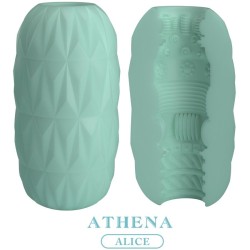
To see whether the idea suits you without spending much, a double-sided masturbation egg:

Small, with a textured interior and two openings:

Small, discreet, waterproof, with a hard case for a bag or suitcase:
And a simple water-based lubricant that works with all of the above:

If you are not sure which lubricant suits which material, the water-based or silicone article explains it. And for what Greeks generally prefer, see what the surveys say.
Frequently asked questions
What is No Nut November?An online challenge in which participants try to avoid masturbation, or the ejaculation that results from it, for the whole of November, as defined by the first study of the phenomenon. It is voluntary and has no official rules. This article is aimed at adults.
We have no reliable support for it. The "7 days" line fits a 2003 paper that was retracted in 2021, and the 2025 NNN study did not measure testosterone. If you worry about your levels, you need a blood test and a doctor.
The 2025 study found no significant difference in sexual wellbeing during abstinence, with the limits we saw (questionnaires, large loss of participants). That does not rule out that it affects someone differently. If you feel anxiety or distress, stop and talk to a professional.
In an analysis of 9,489 samples, motility and morphology fell on days 11-14 of abstinence. It does not speak about pregnancies. If you are planning a child or have semen analysis results, your doctor is the right address.
ICD-11 does not judge frequency. It describes a long-lasting failure to control with marked distress or impairment in life. If you recognise yourself there, talk to a sexologist or psychologist. No diagnosis is made here.
In a large observational study, more ejaculations were associated with fewer prostate cancer diagnoses. An association does not prove a cause, and abstinence was not tested. For a prostate check, ask a urologist.
Have a question?